Shantou is one of the most important manufacturing and export-oriented cities in eastern Guangdong Province and serves as a major production center within China's coastal supply chain. The city has developed highly specialized industrial clusters in toys, textiles, plastics, packaging materials, food products, stationery, and consumer goods manufacturing. Numerous factories in Shantou export products to North America, Europe, Southeast Asia, and the Middle East.
International buyers are often attracted by Shantou's competitive pricing, flexible production capabilities, and extensive supplier network. However, the manufacturing ecosystem is highly fragmented. Production may involve multiple factories, subcontractors, and trading companies, making it difficult for overseas buyers to determine who is actually responsible when problems arise. Disputes frequently emerge after substantial deposits have been paid or after products have already been shipped overseas.
Unlike large industrial cities dominated by publicly listed manufacturers, many suppliers in Shantou are small and medium-sized enterprises. This structure creates unique legal risks. Factories may suddenly cease operations, move production to undisclosed facilities, or experience severe cash-flow difficulties. By the time foreign buyers discover the problem, suppliers may already have transferred inventory or depleted bank accounts, significantly complicating recovery efforts.
Why Legal Risks Accumulate:
Hidden Subcontracting: Production may be transferred to third-party factories without the buyer's knowledge or approval.
Quality Variations: Products often differ from approved samples, specifications, or packaging requirements.
Seasonal Production Pressures: Peak export seasons frequently result in delays, rushed manufacturing, and inadequate quality control.
Supplier Insolvency: Smaller manufacturers may encounter financial difficulties and refuse refunds or abandon orders entirely.
Evidence Challenges: Many transactions rely heavily on WeChat communications and Proforma Invoices rather than comprehensive supply agreements.
If your company is dealing with defective products, delayed shipments, deposit losses, or supplier non-performance in Shantou, early legal intervention often makes a significant difference. Prompt evidence preservation, supplier investigations, and asset preservation measures may substantially improve the likelihood of recovering losses and reaching an effective commercial resolution.
Common Shantou Supplier Disputes
We frequently advise international companies on the following disputes involving suppliers located in Shantou:
Quality & Specification Disputes
Products differing from approved samples, technical requirements, or packaging specifications.
Deposit Recovery
Suppliers refusing to commence production or refusing to refund advance payments.
Delivery & Supply Chain Disputes
Late shipments, incomplete deliveries, and contractual non-performance.
Regional Coverage:
We regularly represent foreign clients in disputes involving manufacturers located in Shantou and other industrial cities throughout Guangdong Province. Our team can coordinate supplier investigations, evidence collection, litigation proceedings, and judgment enforcement remotely.
Our Strategic Approach
Evidence Preservation: Secure contracts, samples, and communications.
Supplier Investigation: Verify factory operations and assets.
Litigation & Asset Preservation: Commence court proceedings and apply for property preservation measures.
Frequently Asked Questions
Common legal inquiries regarding supplier disputes and commercial litigation involving suppliers in Shantou.
1. Can you help if a Shantou supplier delivered products that fail to meet quality standards?
Yes. We regularly assist international buyers in disputes involving defective toys, textiles, food products, and consumer goods manufactured in Shantou. We review contracts, inspection reports, technical specifications, and communication records to establish breach of contract and pursue refunds, replacement products, or compensation.
2. What if the factory used different materials from the approved samples?
This is a common issue in manufacturing disputes. We compare approved samples, purchase specifications, packaging requirements, and production records to determine whether the supplier substituted materials or altered production processes without authorization. Such conduct may constitute a breach of contract and result in liability for damages.
3. Can WeChat conversations and emails be used as evidence in Chinese courts?
Yes. In many cross-border transactions, WeChat and email communications contain critical evidence regarding pricing, specifications, delivery schedules, and settlement discussions. We assist clients in preserving and organizing electronic evidence so that it can be properly presented in Chinese litigation proceedings.
4. What if the supplier has stopped responding after receiving my deposit?
We can investigate the supplier's business status, verify whether the factory remains operational, and assess available assets. Depending on the circumstances, we may issue lawyer demand letters, negotiate directly with the supplier, or initiate court proceedings and seek property preservation measures to improve the chances of recovering your funds.
5. Is it possible to freeze a supplier's bank accounts before litigation?
Yes. Chinese law allows courts to grant pre-litigation property preservation in appropriate circumstances. Depending on the available evidence and the risk of asset dissipation, we may apply to freeze bank accounts, inventory, receivables, or other assets before formal litigation begins.
6. Do I need to travel to Shantou or China to pursue legal action?
In many cases, no. We frequently represent overseas companies remotely. We can coordinate evidence collection, supplier investigations, negotiations, litigation filings, and enforcement procedures on behalf of foreign clients, significantly reducing the need for international travel and allowing disputes to be handled efficiently from abroad.
The following PRC-licensed attorneys are responsible for handling supplier disputes, commercial litigation, debt recovery, and related legal matters involving Shantou-based manufacturers and suppliers.
Education: B.A., LL.M.
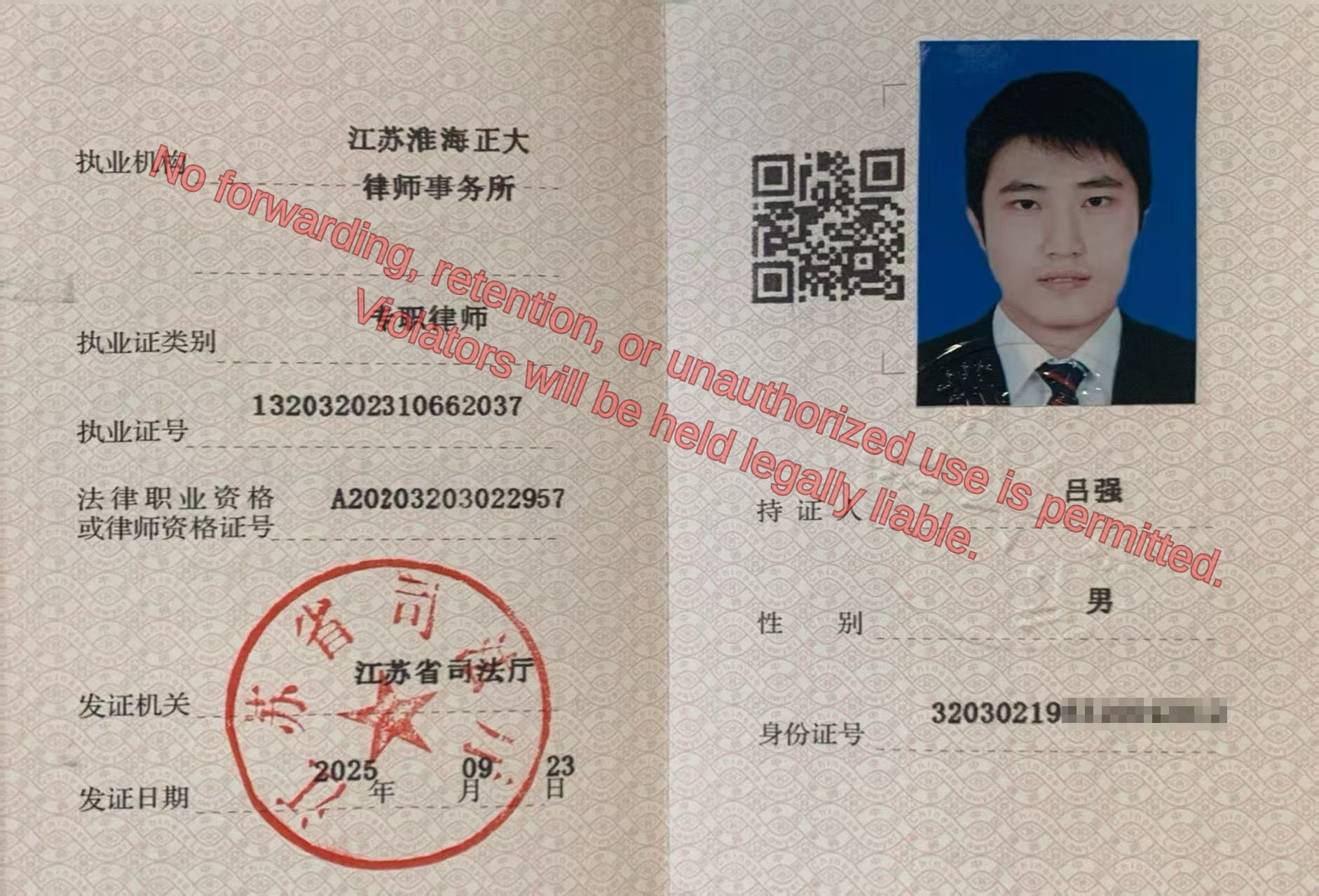
License No. 13203202310662037 Languages: English · Mandarin Chinese · Japanese
Mr. Lyu has over a decade of continuous legal and commercial experience in cross-border business environments, combining private legal practice with substantial in-house counsel work.
He is a PRC-licensed attorney and holds an LL.M. degree from the University of California, Los Angeles (UCLA), with a multidisciplinary background in law, accounting, and international studies.
His practice focuses on supplier disputes, commercial litigation, debt recovery, intellectual property disputes, and cross-border enforcement matters involving Chinese manufacturers and foreign companies.
English Translation:
Name: Qiang Lyu
License No.: 13203202310662037
Qualification No.: A20203203022957
Admitted By: Department of Justice, Jiangsu Province
Date of Issue: September 23, 2025
Practice Type: Full-time Attorney
Law Firm: Jiangsu Huaihai Zhengda Law Firm
ID Number: [Redacted for Privacy]
Note: Sensitive personal information has been redacted in compliance with privacy best practices.
Liang Zhu
Attorney-at-Law (PRC)
Education: B.S., LL.B.
License No. 13203202310613140 Languages: English · Mandarin Chinese
Mr. Zhu is a dual-qualified professional holding both a PRC legal license and a Senior Enterprise Compliance Officer certification.
His practice focuses on commercial disputes involving construction, labor arbitration, product quality, and supply chain conflicts.
He provides tailored legal support to foreign buyers dealing with Shandong-based suppliers, particularly in evidence collection, on-site verification, supplier investigations, and dispute coordination.
Mr. Zhu’s corporate background enables him to understand client operational realities and deliver pragmatic, business-oriented legal solutions.
Tao Dong
Attorney-at-Law (PRC)
Education: B.S., LL.B. License No. 13203202310603090 Languages: English · Mandarin Chinese
Mr. Dong is a PRC-licensed attorney with extensive experience in contract disputes, intellectual property enforcement, and corporate law. He began his legal career in 2008 at a major state-owned enterprise. Starting in 2014, he worked in Beijing on cross-border intellectual property and construction equipment matters.
Admitted to the Jiangsu Provincial Bar, Mr. Dong combines deep industry knowledge with practical litigation skills to resolve complex commercial disputes for both domestic and international clients.
Ke Yang
Attorney-at-Law (PRC)
Education: LL.B. License No. 13203202210417710 Languages: English · Mandarin Chinese
Mr. Yang is a PRC-licensed attorney specializing in government legal advisory, criminal defense, and family law. He holds a Bachelor of Laws and has served as legal counsel to various government agencies in Xuzhou and Peixian County, including departments responsible for urban management, market regulation, and housing.
Known for his strategic approach to litigation and his interdisciplinary understanding of law, finance, and public administration, Mr. Yang provides effective representation to both institutional and individual clients in complex legal matters.
Scroll to Top
Welcome to our website.
Thank you for visiting our website.
To help us evaluate your matter efficiently, please provide:
• Your country
• The Chinese company's city
• A brief description of the dispute
• The amount in dispute
We will review your inquiry and reply as soon as possible.